

Anatomy of a Patent
The anatomy of a patent is its fixed layout: a front page of coded bibliographic data, then the drawing sheets, then a specification printed in numbered columns that ends with the claims. Each part answers a different question. The front page and the drawings identify and teach the invention, while the claims set the legal boundary. This guide walks through one granted patent, page by page, with each part marked in red.
At a Glance
- The specimen: U.S. Patent No. 12,728,225 B2, granted September 8, 2026 to The Regents of the University of California, prosecuted by our firm
- The front page: numbered field codes identify the owner, the filing and priority dates, the classification and the references the examiner saw
- The drawings and description: they teach the invention and supply the vocabulary used to read the claims
- The claims: the numbered sentences at the end are the only part that defines what the owner can stop others from doing
- The research leads: the front-page codes and names double as search keys, and free USPTO tools show which later patents cited this one
How Is a Granted Patent Laid Out?
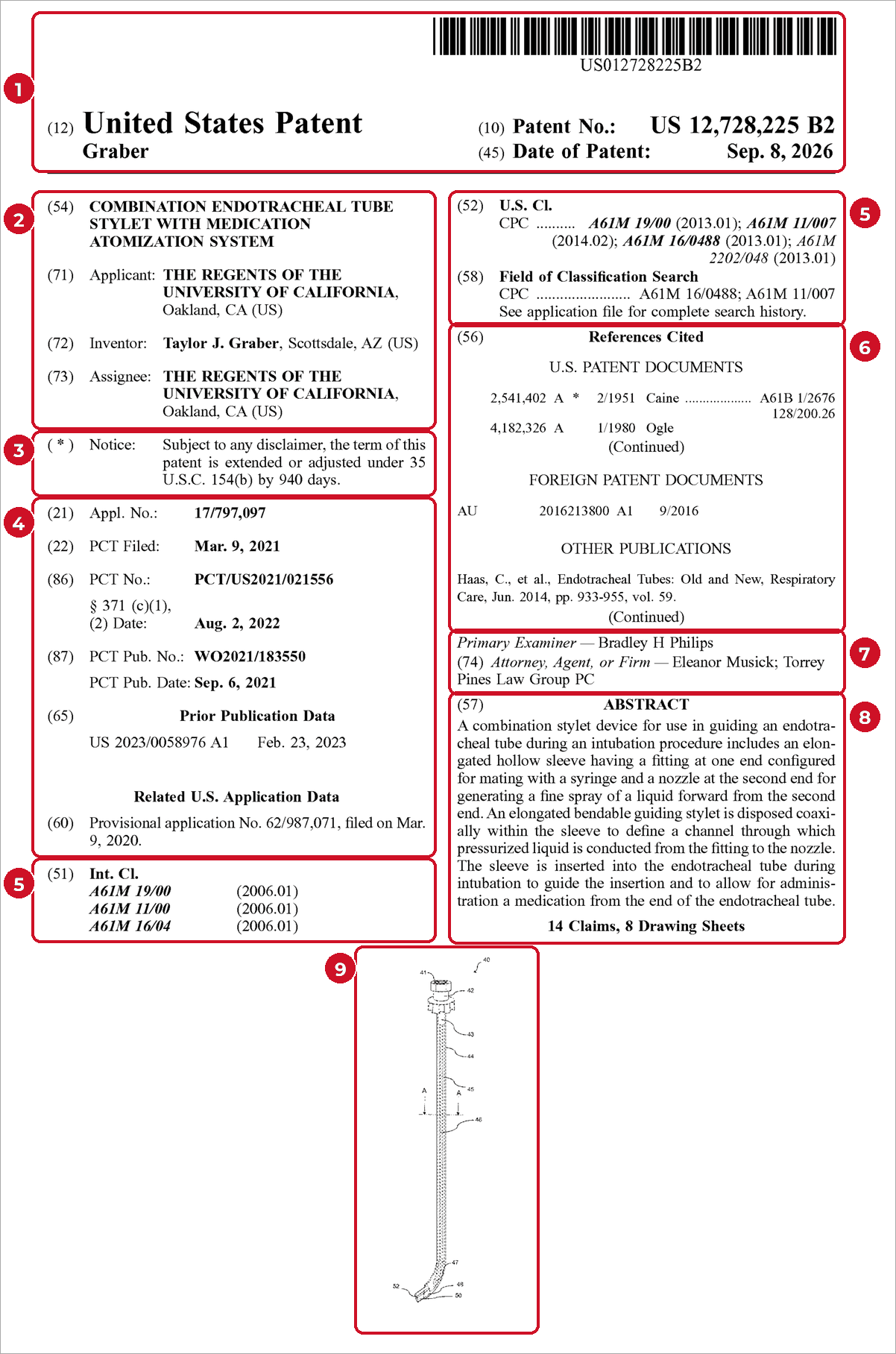
A granted U.S. patent is laid out in a fixed order: the front page, any continuation of the reference list, the drawing sheets, and then the specification, which closes with the claims. Our example runs 14 pages. Page 1 is the front page, page 2 continues its list of references, pages 3 through 10 are eight drawing sheets, and pages 11 through 14 hold the written description and the 14 claims. The front-page fields follow numbered codes from an international standard, so a reader in Munich or Tokyo can find the filing date on a U.S. patent without reading English.
To follow along, open the full U.S. Patent No. 12,728,225 B2 from the USPTO (PDF, 14 pages) and keep it beside this page.
What Does the Front-Page Header Tell You?
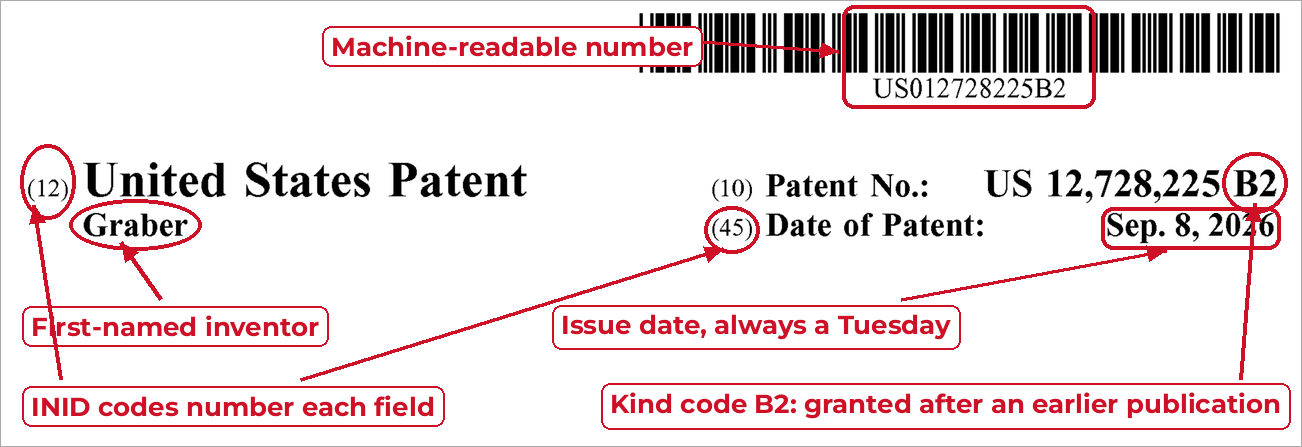
The header tells you the patent number, the kind of document, the first-named inventor and the issue date. The two letters after the number are the kind code. Under the USPTO's kind codes, B2 means a granted patent whose application was published before grant, B1 means a granted patent with no earlier publication, and A1 marks the published application itself. Our example is a B2 because its application was published in February 2023. The surname under "United States Patent" is the first-named inventor, which is why lawyers refer to patents by inventor ("the Graber patent") and occasionally confuse their clients.
The small numbers in parentheses are INID codes, the field numbers set by WIPO Standard ST.9. Code (10) is the document number, (45) is the date of the patent, and (12) names the type of document. U.S. patents issue on Tuesdays, and the date of the patent is the day the owner's rights begin.
Research tip: the B2 tells you a published application exists, and its number sits in field (65). Pull up US 2023/0058976 A1 beside the granted patent and compare the claims. The published claims are what the applicant asked for, and the granted claims are what the examiner allowed. The gap between them is a quick measure of what examination took away.
Who Are the Inventor, the Applicant and the Assignee?
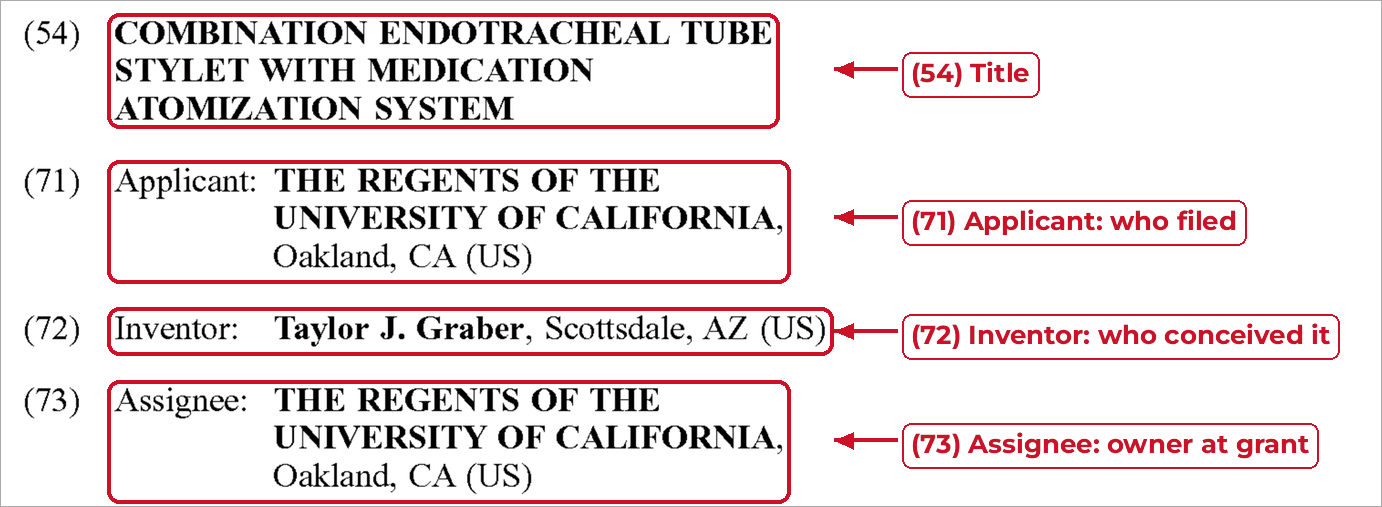
The inventor is the person who conceived the claimed invention, the applicant is the party that filed the application, and the assignee is the owner recorded when the patent issued. They are often different. Here the inventor (72) is Taylor J. Graber of Scottsdale, Arizona, while the applicant (71) and the assignee (73) are The Regents of the University of California. That pattern is typical of university inventions, where an employment or policy agreement assigns the inventor's rights to the institution.
The assignee field is a snapshot at grant. Ownership can change afterward, and later transfers appear only in the USPTO Assignment Center. A buyer who relies on the printed assignee alone is doing diligence the way some lawyers read contracts: confidently, and only the first page. The title (54) can run up to 500 characters under the USPTO rule on titles and abstracts, though it describes the subject and does not limit the claims.
Research tip: the inventor field works as a search key. In the USPTO's free Patent Public Search tool, the Advanced Search query Graber.IN. returns every U.S. patent and published application naming that inventor, and the USPTO's list of searchable indexes shows how to add a city to separate one Graber from another. An inventor's other filings often show the earlier version of an idea or the later improvement on it. The same trick with the assignee field ("Regents of the University of California".AS.) maps an owner's portfolio. Check the inventor's journal articles and conference talks as well. A paper published more than a year before the earliest priority date can be prior art even against the inventor's own patent, which surprises inventors far more often than it surprises their lawyers.
How Long Does the Patent Last, and What Is Patent Term Adjustment?
A U.S. utility patent generally lasts 20 years from its earliest non-provisional filing date, extended day for day by any patent term adjustment the Office grants for its own delays. The starred notice on the front page reports that adjustment. Our example received 940 days. Its 20-year term runs from the international filing date of March 9, 2021, and 940 days of patent term adjustment push the expected expiration to about October 5, 2043, assuming the owner pays every maintenance fee. The USPTO's explanation of patent term describes how adjustment credits Office delay and subtracts delay caused by the applicant.
The phrase "subject to any disclaimer" in the same notice is a warning. A terminal disclaimer, filed to overcome a rejection over the owner's own related patent, can cut the term short, and it shows up in the file history. Patent lawyers like to call 940 days of adjustment a good result, as though they had personally slowed the Office down.
Research tip: look the patent up by its application number in Patent Center. Its Patent Term Adjustment tab shows the Office's day-by-day calculation behind the 940 days, and its fee payment history tab shows whether the owner has kept the patent alive.

What Do the Filing and Priority Fields Show?
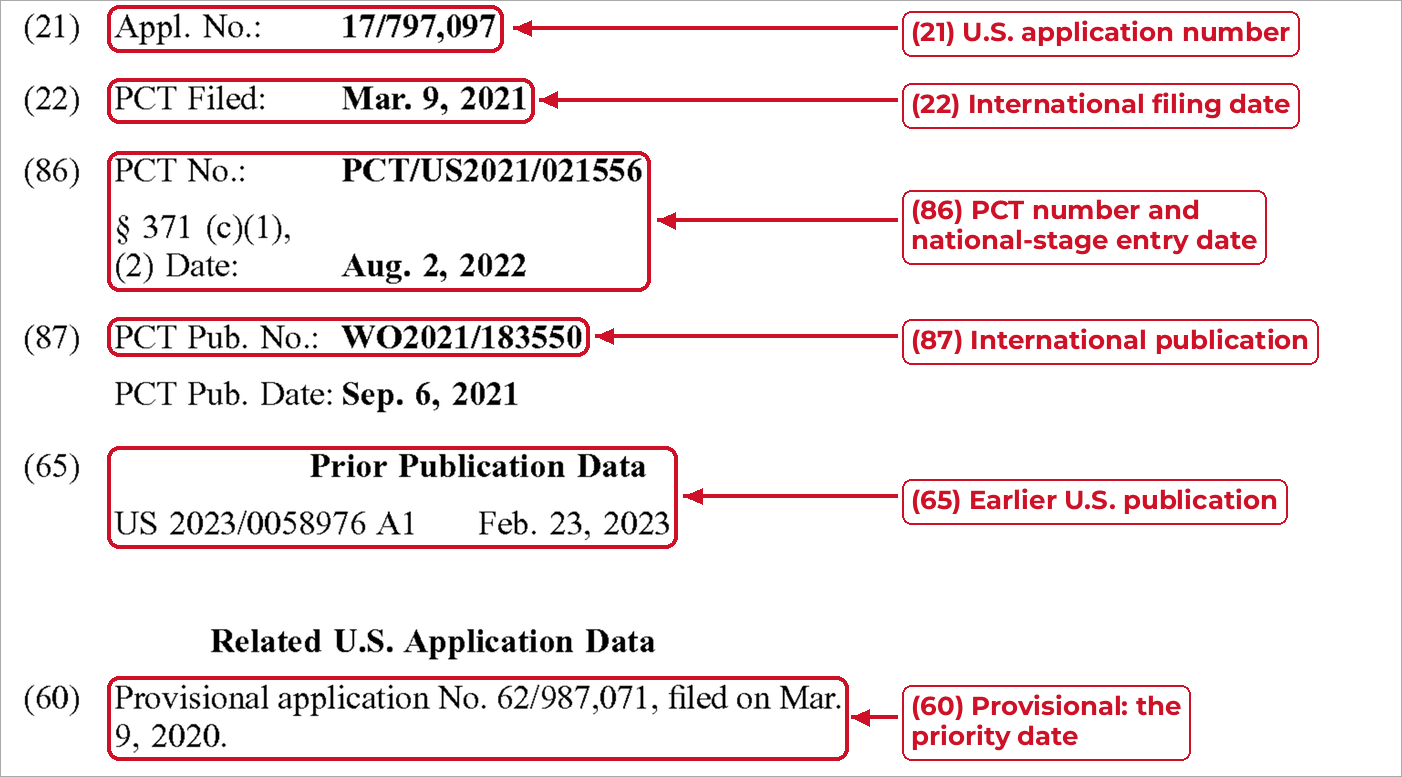
The filing and priority fields show the history of the application and, most importantly, the earliest date the patent can rely on against earlier technology. Reading from the bottom up, field (60) lists a provisional application filed March 9, 2020. Exactly one year later, the applicant filed an international application under the Patent Cooperation Treaty, shown in fields (22) and (86). It was published internationally as WO2021/183550 (field 87), then entered the U.S. national stage on August 2, 2022, the point at which an international application becomes a U.S. application, here U.S. application 17/797,097 (field 21). The United States published it as US 2023/0058976 A1 on February 23, 2023 (field 65).
The provisional matters for priority and does not start the 20-year clock. According to the USPTO's guide to provisional applications, the 12-month provisional period does not count toward the term. The U.S. publication date matters for a different reason. The Patent Act gives an owner provisional rights to a reasonable royalty for use between publication and grant, if the issued claims are substantially identical to the published ones and the user had actual notice of the published application, under the provisional-rights provision.
Research tip: the front page shows the parents of a patent and never its children. Patent Center's Continuity tab lists both, including any continuation filed after this patent issued. A pending continuation can still collect new claims drafted with a competitor's product in view, so a clean read of the granted claims does not end the analysis. For the family abroad, enter the U.S. application number in the USPTO's Global Dossier. It gathers the family members filed at the five largest patent offices, along with their office actions and machine translations, and its citation list ranks the art cited anywhere in the family, most often cited first, according to the USPTO's Global Dossier page.
What Do the Classification Codes Mean?
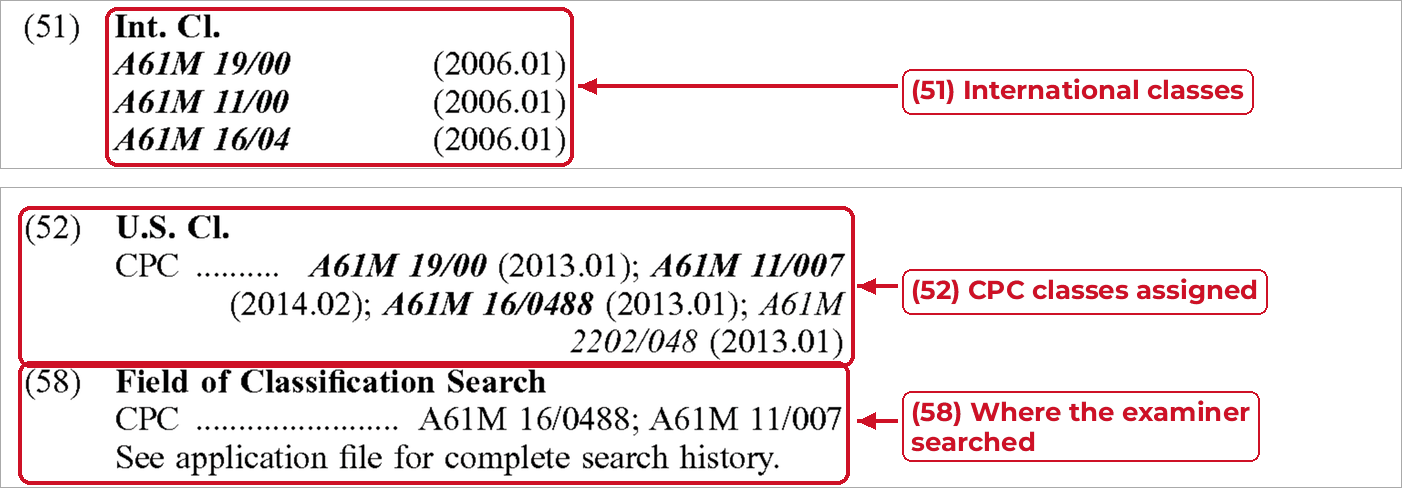
The classification codes place the invention in a technology category so that examiners and searchers can find it with similar patents. Field (51) gives the International Patent Classification codes, and field (52) gives the Cooperative Patent Classification codes, a system the USPTO runs jointly with the European Patent Office and adopted in January 2013. All of our example's codes start with A61M, the class for devices that introduce media into the body. Field (58) records where the examiner searched. Here it lists two subgroups and refers the reader to the application file for the complete search history, which is the place to check before assuming the examiner missed something.
Research tip: a classification code narrows a related-art search far better than keywords alone, because patent drafters rarely call a tube a tube. Our example carries A61M 16/0488, which the USPTO's CPC scheme for A61M defines as mouthpieces and means for guiding, securing or introducing tubes. In Patent Public Search, the query A61M16/0488.CPC. AND (spray$ OR atomiz$) returns patents and applications in that subgroup that mention spraying, whatever words they use for the stylet. Type the code without spaces, as the Patent Public Search FAQs instruct. The codes the examiner listed in field (58) are a second starting point, since they show where the examiner already looked.
What Are the References Cited, and Why Do the Asterisks Matter?
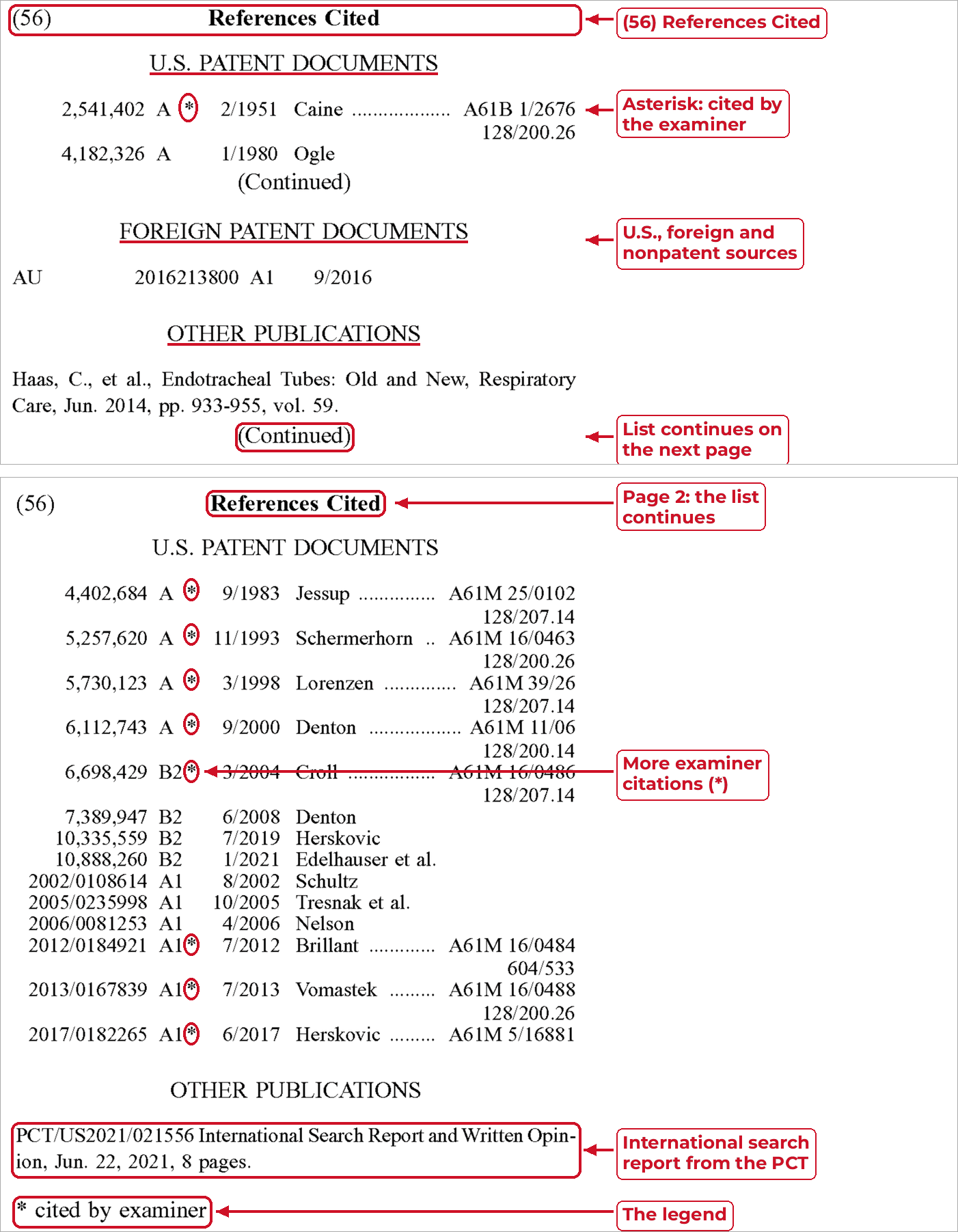
The references cited in field (56) are the earlier patents and publications that were before the examiner, and an asterisk marks the ones the examiner found. References without an asterisk usually came from the applicant, who owes the Office a duty of disclosure of known information material to patentability. Our example's list starts on the front page and continues on page 2, where the legend "cited by examiner" explains the asterisks and an international search report from the PCT stage is listed among the other publications.
The list matters in court. An issued patent is presumed valid, and a challenger must prove invalidity by clear and convincing evidence. In Microsoft Corp. v. i4i Ltd. Partnership, the Supreme Court held that the same standard applies to references the Office never saw, while allowing a jury to be told that the Office had no chance to weigh them. A reference printed on the face of the patent is one the examiner had in hand, which makes it harder to sell to a jury as a surprise.
Research tip: the references cited look backward, and the more interesting list looks forward. Electronically you can see every later patent and published application that cited this very patent. In Patent Public Search, the document viewer has a forward-citation button (the closing quotation mark), and the query 12728225.URPN. finds the U.S. documents that list it as a reference. The USPTO's seven-step search strategy recommends running both directions. Google Patents shows the same information on each patent's page, under "Cited By," once there is something to show. Forward citations map who is working nearby, and a company whose application cites this patent has, at the least, been told it exists. A patent granted in September 2026 will have few or none yet, so check back.
Who Examined the Patent, and Who Prosecuted It?
The examiner's name and the attorney of record both appear just above the abstract. The primary examiner here is Bradley H Philips. Field (74) names the attorney, agent or firm that handled prosecution, which for this patent is Eleanor Musick of Torrey Pines Law Group. That's us, which is one reason we picked this patent: we can mark it up in red without asking permission from a competitor.
Both names are useful leads. The examiner's other cases show how that examiner and that examining group treat similar claims, and the firm in field (74) is the first place to send questions about the file, at least until the owner moves the file elsewhere.
Research tip: in Patent Public Search, Philips.XP. retrieves patents with this primary examiner. Pair it with the CPC code to see what claim language the examiner has allowed in this art, which is a better forecast than any lawyer's confident hunch.

What Is the Abstract For?
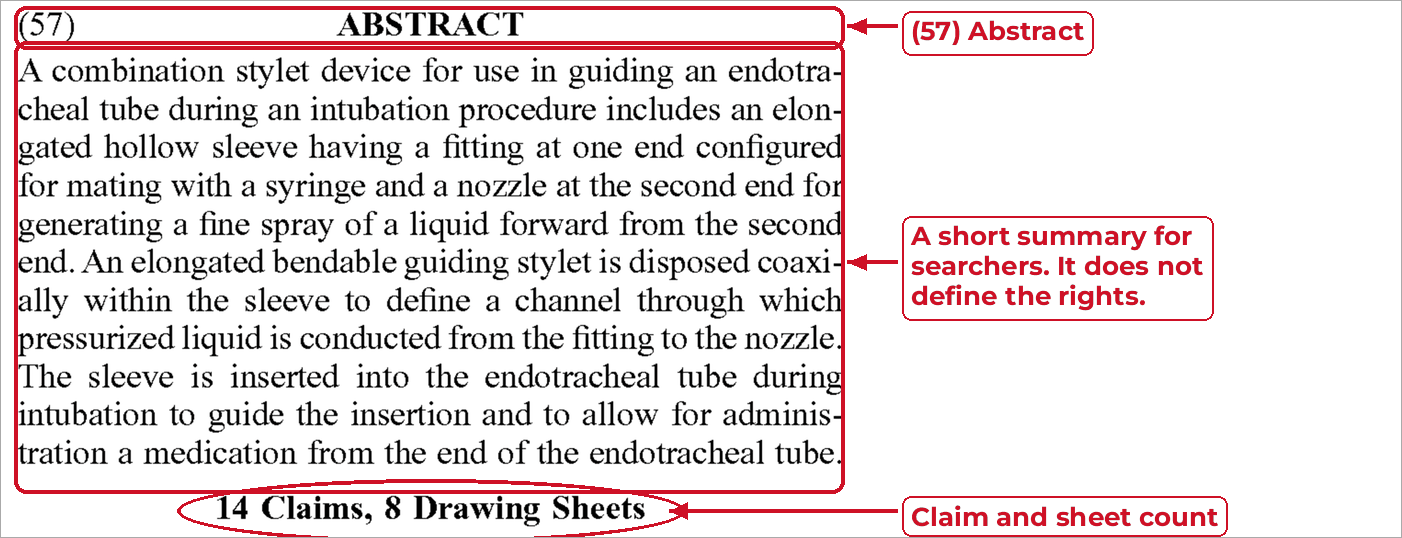
The abstract is a short summary written so searchers can grasp the invention at a glance. The USPTO rule on abstracts says its purpose is to let the Office and the public "determine quickly from a cursory inspection the nature and gist of the technical disclosure," and it should preferably stay within 150 words. The abstract is the wrong place to look for the scope of protection. A competitor who designs around the abstract has designed around a book jacket. The line beneath it, "14 Claims, 8 Drawing Sheets," gives the counts.
How Should You Read the Patent Drawings?
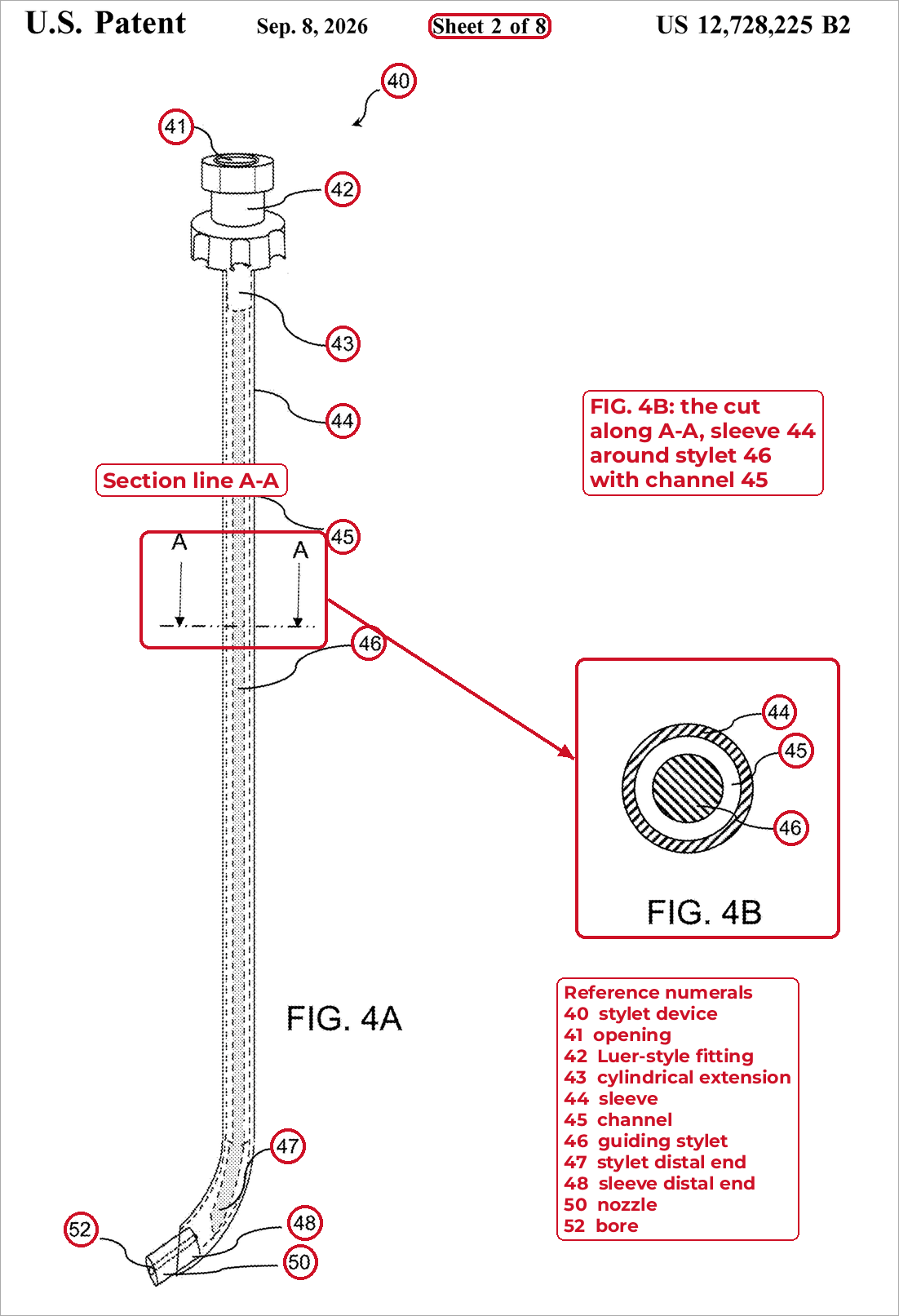
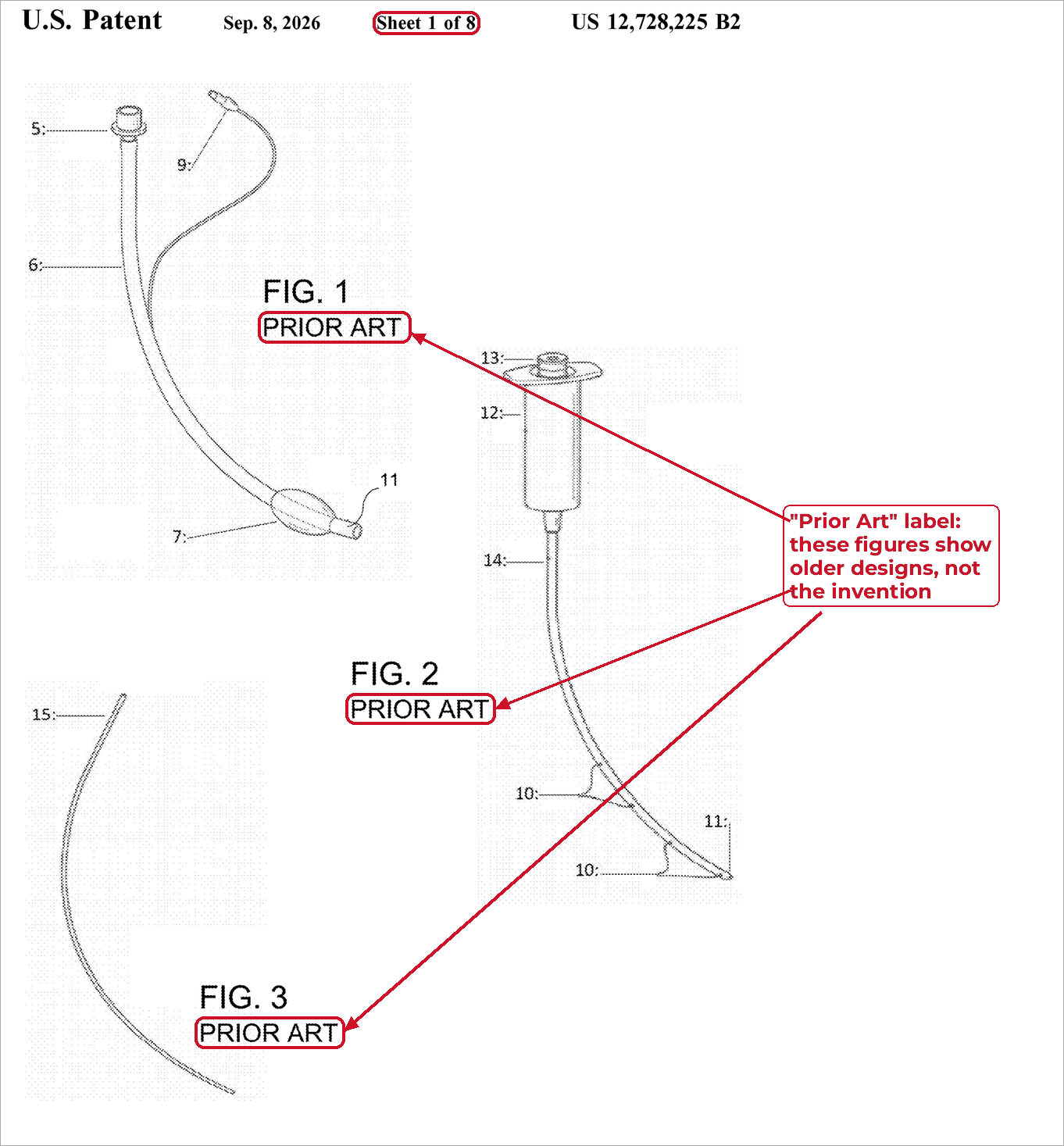
You read patent drawings by following the reference numerals from figure to figure and into the text. Each numeral names one part, and the USPTO drawing rules require the same numeral for the same part in every view. In FIG. 4A of our example, 40 is the stylet device, 42 the Luer-style fitting, 44 the sleeve, 46 the guiding stylet and 50 the nozzle. The section line marked A-A shows where FIG. 4B cuts across the device to reveal channel 45 between sleeve 44 and stylet 46. The representative drawing on the front page is simply FIG. 4A repeated.
Figures labeled "Prior Art" show earlier technology, here a conventional breathing tube with its guiding wire and an older device for spraying anesthetic into the airway. They set up the problem the invention solves. They are also the applicant's own statement about what came before, and a challenger may quote them back later, so careful drafters label them with the same care they give the claims.
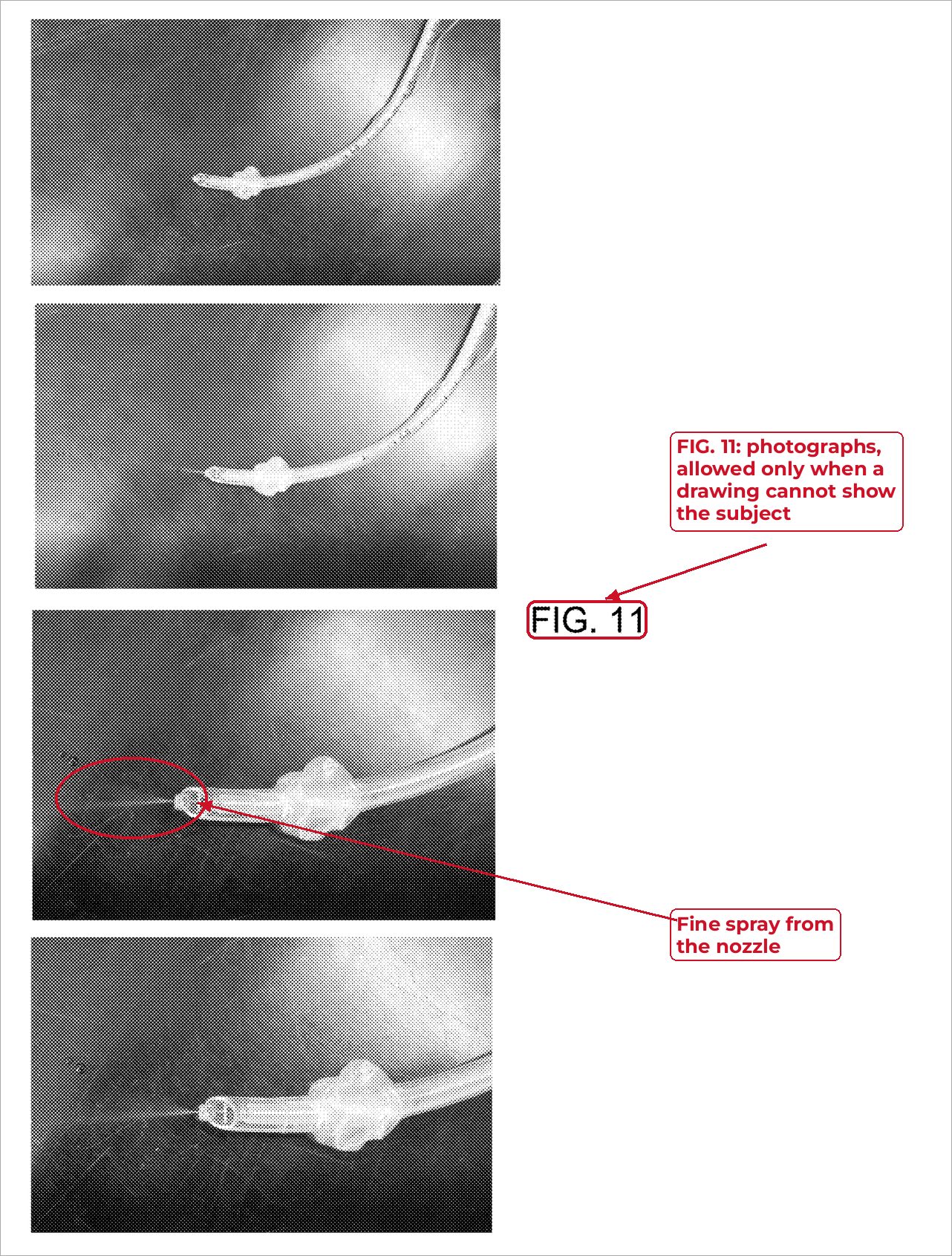
Photographs are allowed only when they are the only practicable way to show the subject, under the same drawing rules. FIG. 11 of our example uses photographs of a prototype to show something line art handles poorly, the fine spray leaving the nozzle. Patent lawyers rarely get to show a working prototype in a patent, so we enjoy it when it happens.
How Is the Patent Specification Organized?
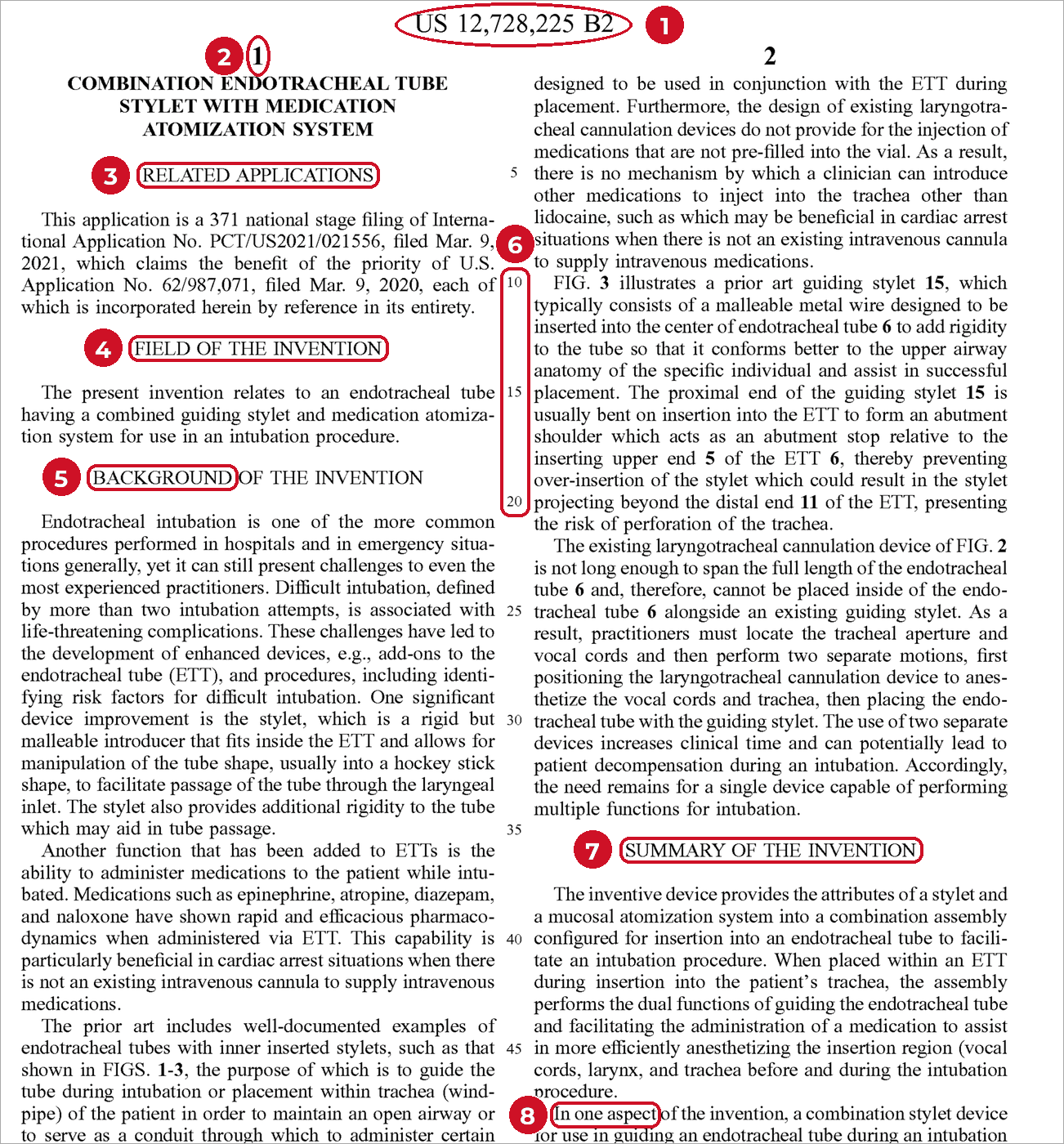
The patent specification is organized in labeled sections printed in two numbered columns, with line numbers every five lines so anyone can cite a passage by column and line. Our example opens with Related Applications, which claims priority to the international and provisional applications and incorporates them by reference, making their text part of this patent. Then come the Field of the Invention, a Background that describes the problem and the older designs in FIGS. 1 to 3, and a Summary of the Invention. The Summary describes the invention in broad terms, often as a series of "aspects," each a version of the invention that later claims can track.
What Does the Detailed Description Do?
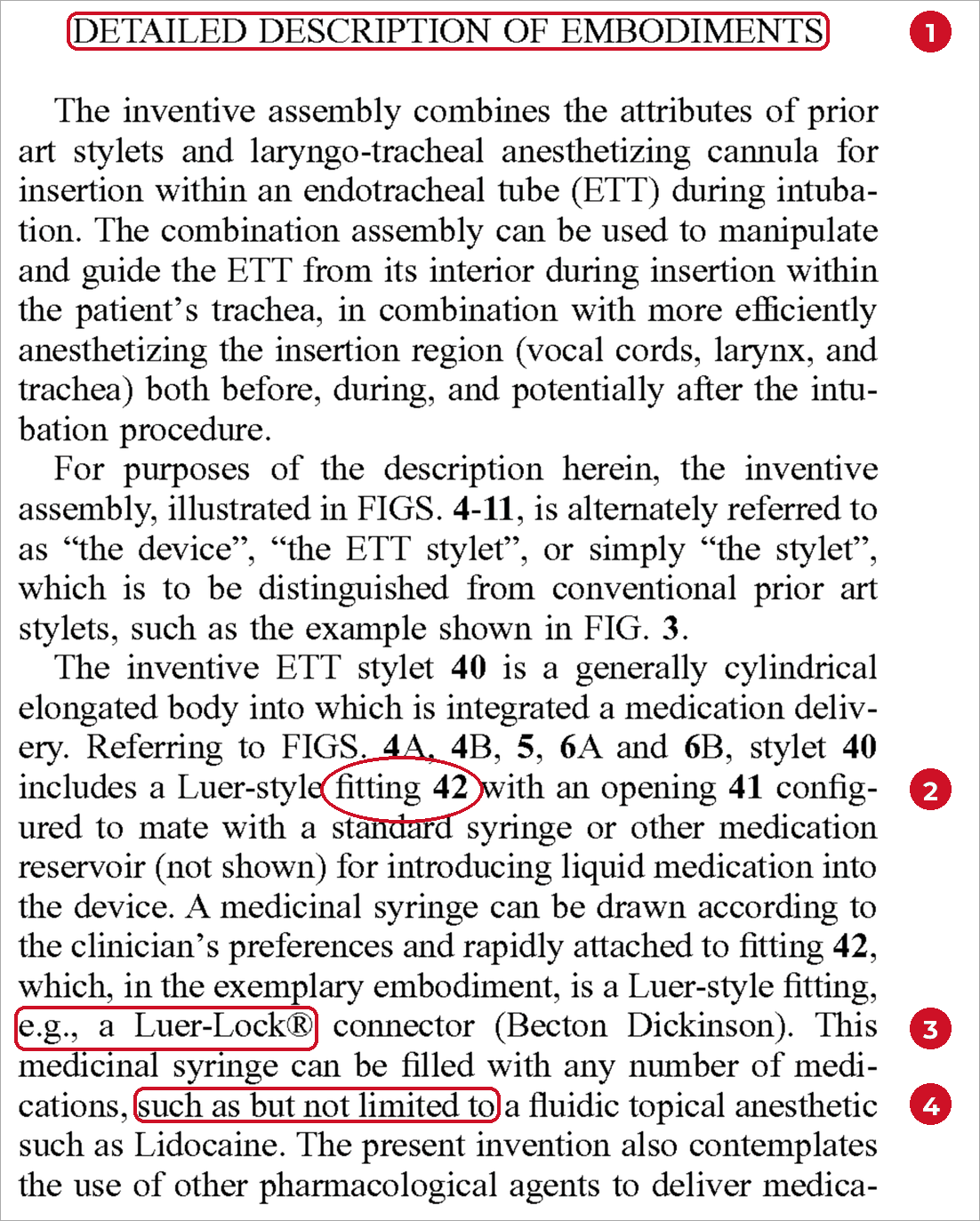
The detailed description teaches how to make and use the invention, walking through the drawings numeral by numeral, and it supplies the vocabulary used to read the claims. In Phillips v. AWH Corp., the Federal Circuit called the specification "the single best guide to the meaning of a disputed term." A careful description therefore uses examples while signaling that they are examples. Our example names a commercial part, "e.g., a Luer-Lock® connector (Becton Dickinson)," and lists medications with the phrase "such as but not limited to." Those phrases keep a single example from becoming the definition of a claim term, which is the patent drafter's version of reading the fine print before signing it.
How Do You Read Patent Claims?
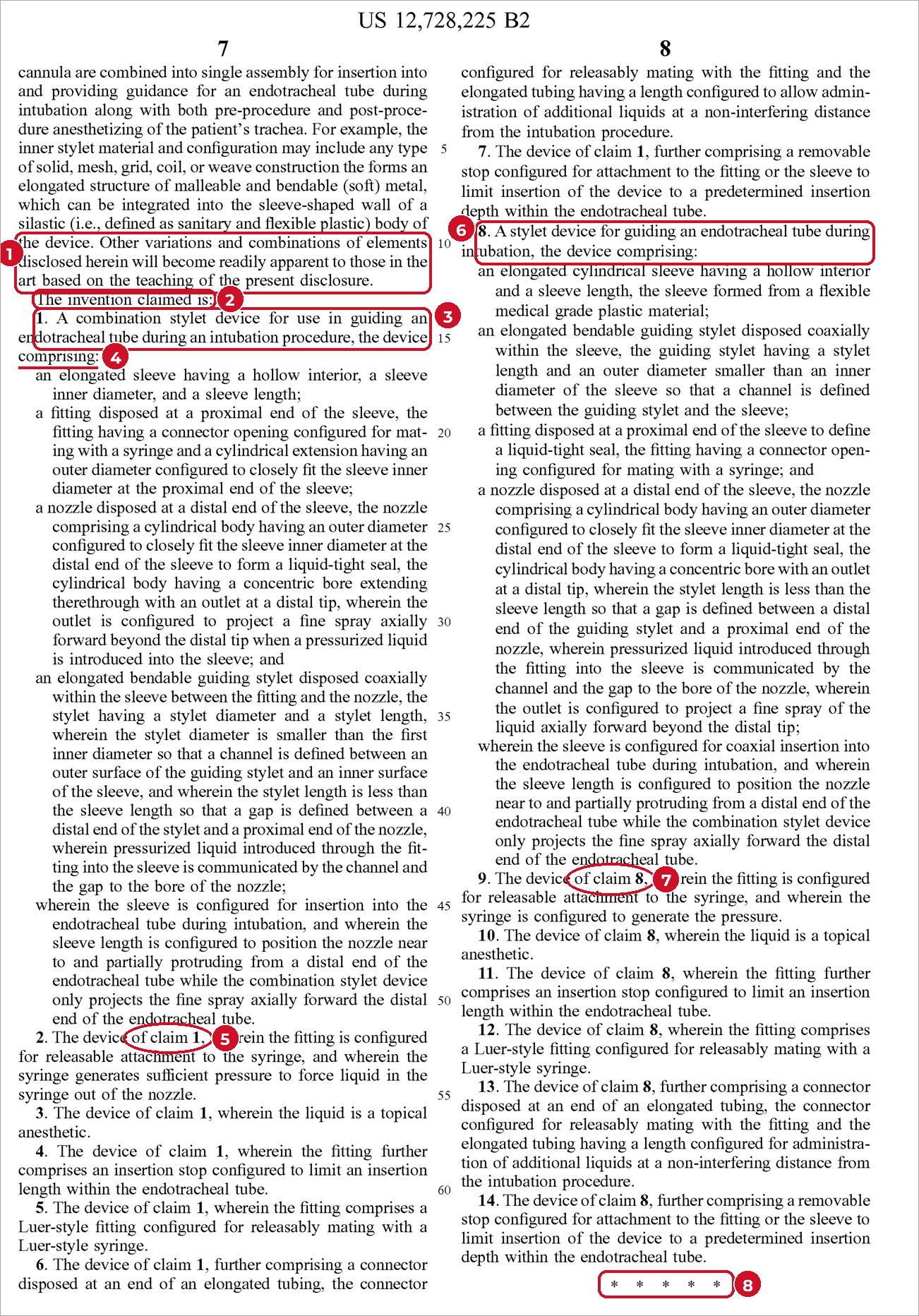
You read patent claims one at a time, as single sentences, each defining a separate right. The claims begin after the words "The invention claimed is" and end at the row of asterisks. Each claim has a preamble that names the thing claimed, a transition word, and a body listing every element. The usual transition, "comprising," is open-ended: a product that has every listed element infringes even if it adds more.
An independent claim stands on its own. A dependent claim refers back to an earlier claim, and under the USPTO claim rules it includes every limitation of the claim it references and then adds one more. Our example's claim 2 ("The device of claim 1, wherein the fitting is configured for releasable attachment to the syringe") is narrower than claim 1, which makes it easier to defend and easier to avoid. Claim drafters argue about commas with the intensity other people save for politics, and with a similar rate of changing anyone's mind.
Why Does a Patent Have More Than One Independent Claim?
A patent has more than one independent claim so that a competitor who avoids one claim can still run into another. Our example has two independent claims, claims 1 and 8, each followed by six dependent claims. Claim 1 requires the fitting to have a cylindrical extension that fits closely inside the sleeve. Claim 8 drops that requirement and instead requires the sleeve to be "formed from a flexible medical grade plastic material." A product with a differently shaped fitting may avoid claim 1 and still meet claim 8.
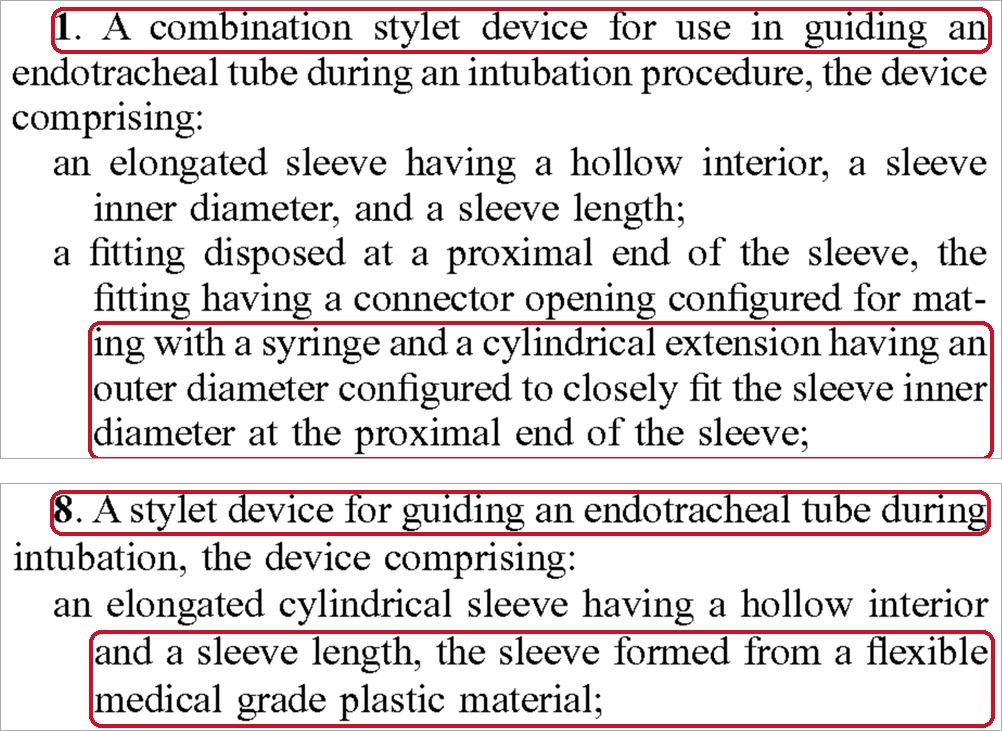
| Element | Claim 1 | Claim 8 |
|---|---|---|
| Preamble | A combination stylet device for use in guiding an endotracheal tube | A stylet device for guiding an endotracheal tube |
| Sleeve | Elongated, with a hollow interior, an inner diameter and a length | Elongated and cylindrical, formed from a flexible medical grade plastic material |
| Fitting | Connector opening for a syringe plus a cylindrical extension closely fitting the sleeve | Connector opening for a syringe, defining a liquid-tight seal; no cylindrical extension required |
| Nozzle and stylet | Nozzle with a concentric bore; bendable stylet inside the sleeve with a channel and a gap | Same structure in substance |
| Position in the tube | Nozzle near to and partly protruding from the end of the breathing tube | Same requirement |
| Dependent claims | Claims 2 to 7 | Claims 9 to 14 |
What Does the Face of a Patent Not Show?
The face of a patent does not show what happened after it was printed. Four things worth checking live elsewhere:
- Maintenance fees. A utility patent expires early unless fees are paid at 3.5, 7.5 and 11.5 years after grant, with a six-month grace period for a surcharge, as the USPTO maintenance page explains. For our example, the first window closes in March 2030.
- Ownership changes. Assignments and security interests recorded after grant appear in the USPTO Assignment Center.
- The file history. Rejections, amendments and arguments made during examination are in Patent Center, and they can narrow how a court reads the claims.
- Later corrections and challenges. Certificates of correction, terminal disclaimers and any Office challenge to the claims are part of the record after grant.
Anyone who values a patent from its front page alone is reading the cover and skipping the plot, a habit lawyers usually reserve for the other side's brief.
Common Questions About the Anatomy of a Patent
What are the main parts of a patent?
The main parts of a patent are the front page of bibliographic data, the drawing sheets and the specification, which ends with the claims. The front page carries the abstract and a representative drawing, and the specification includes the background, summary and detailed description.
Which part of a patent defines what it covers?
The claims define what a patent covers. The title, abstract and drawings help explain the invention, and the detailed description guides how claim terms are read, but only the claims set the boundary of the owner's rights.
What does B2 mean after a patent number?
B2 means the document is a granted patent whose application was published before grant. B1 marks a granted patent with no earlier publication, and A1 marks a published application.
What does an asterisk in the references cited mean?
An asterisk marks a reference cited by the examiner. References without an asterisk usually came from the applicant under the duty of disclosure.
How can you find the patents that cite a patent?
Open the patent in the USPTO's Patent Public Search and use the forward-citation button, or search its number in the URPN field, for example 12728225.URPN.. Google Patents lists the same later documents under "Cited By" on the patent's page.
Patents reward slow reading, one of the few lawyerly habits that nobody tries to cure. If you want a patent in your portfolio, or a competitor's, read with that kind of care, contact us.
This FAQ provides general information, not legal advice, and does not create an attorney-client relationship. Outcomes depend on specific facts and jurisdictions. See our Legal Notices.




